Blog

Outcome Based Hiring Is Leadership, Not Paperwork

Most job descriptions still look the same: a company bio, a role summary, tasks, requirements, and, on a good day, pay and benefits.

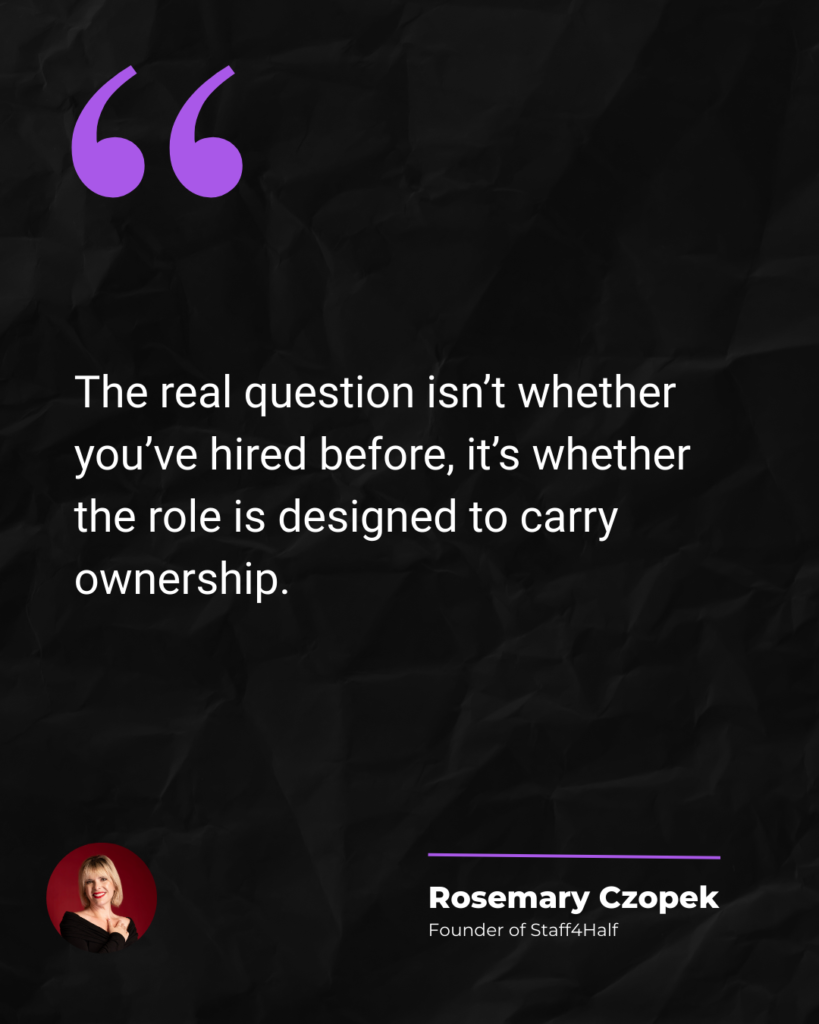
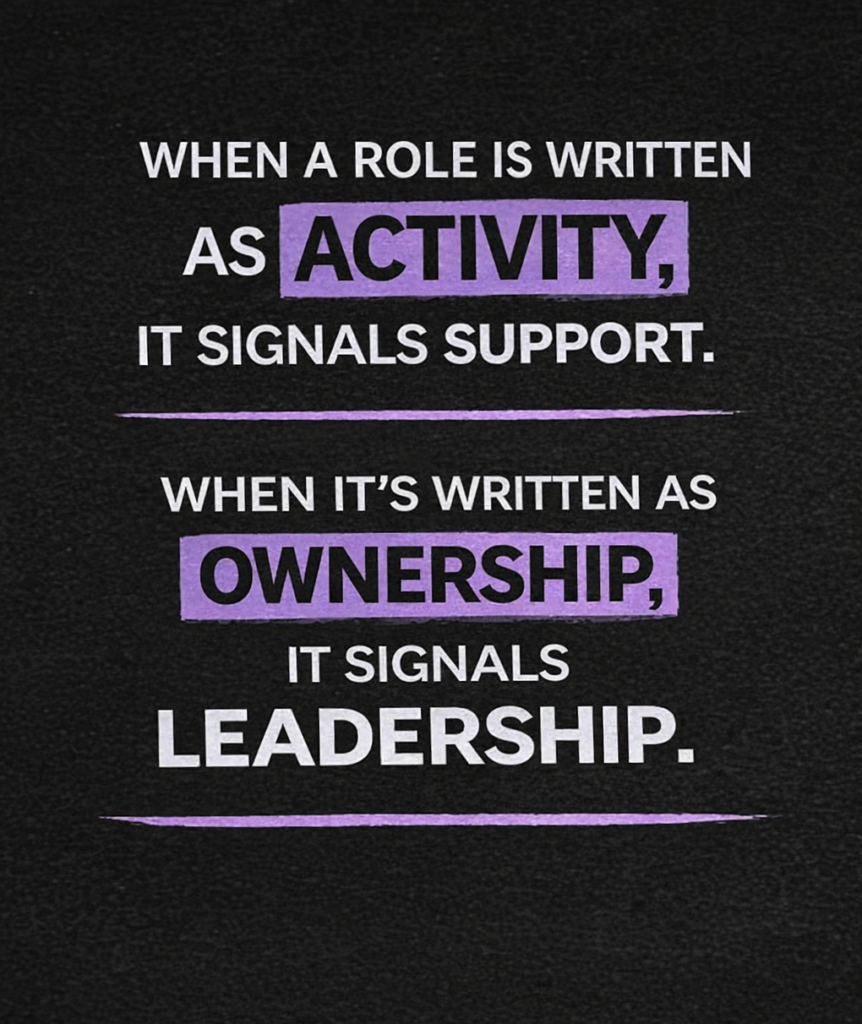
It’s a clear structure and it works for assistant level roles. But for any role that carries ownership, and no founder wants a team without ownership, this structure leaves out the one thing that matters most: outcomes.

When we hire only with tasks or responsibilities, we unintentionally set the tone for micromanagement. We define the “how” before we’ve even met the person we hope to trust with the role. We position ourselves as the strategists and our team as the doers, skipping the most important part of leadership: defining what success actually looks like.

Outcome based hiring changes that.
It forces clarity.
It attracts candidates who believe they can achieve what is being asked.
It creates space for people to bring their own thinking, their own process, and their own ownership.

It is how you build a team that scales without pulling you back into the details.

This doesn’t mean tasks have to disappear because day to day examples help candidates understand the flow of the role. But they should support the outcomes, not replace them.

The balance looks like this:
• Be honest about the actions the role requires.
• Be even clearer about the results that matter.
• And let the right people show you how they will deliver them.

Why AI Will Make Argentina Shine Even More

There’s been a lot of talk about how AI is changing outsourcing. I’d like to share what I’m seeing. For years, outsourcing meant sending low-complexity tasks to the cheapest countries: – Data entry.  – Basic support.  – Repetitive work. The kind of labour that was time consuming, and could be done with little judgment. AI is wiping that model out and the countries that built their economies on routine, high-volume work are feeling it first: – Philippines,  – India, and  – Bangladesh.  And then there are the less prominent outsourcing countries that I believe will now shine more than ever. What countries are those? There are tasks where AI can do 80% of the task, but the remaining 20% require something completely different: reasoning,  – communication,  – clarity, and good judgment. And that is exactly where Argentina shines. When I first started working with Argentina, I didn’t know what to expect, and what I found was something AI can’t replace: – creativity,  – sharp thinking, and a level of  – cultural alignment that makes collaboration effortless. What used to be “outsourcing” has become something different:   Smart outsourcing. People who supervise AI, not compete with it. People who can make decisions, solve problems, and communicate clearly and use AI to 10x their output. That’s why I am so excited about the future of Argentina because the people in Buenos Aires, Córdoba, and Rosario are not “cheap talent.” They’re exceptional talent in a world where exceptional matters more than ever. AI is changing outsourcing and as it does that, it’s also revealing something important: The future belongs to countries with judgment, adaptability, and talent density. And Argentina is one of the strongest examples I’ve ever seen.

I Met a Billionaire. Here’s What Really Changed.

Founders think meeting a billionaire will chance their business. I met one. What did it change?” Last week, I spent a few days on Necker Island with Richard Branson as part of an Entrepreneurs’​ Organization event. Beautiful setting, incredible hospitality, unforgettable activities. I expected some great insights and learnings from the conversations with Richard himself, an entrepreneur who’s achieved what we all can only dream about. Here’s what I didn’t expect: The most valuable conversations didn’t happen with Sir R, they happened with the other entrepreneurs in the room. People solving problems in businesses with real constraints. People asking the same questions I’m asking. What stayed with me wasn’t a quote from the stage or a moment of brilliance from Sir R. It was the honesty in late-night conversations. The feeling of being seen and understood among peers. The shared challenges and the practical ideas. The feeling of, “Oh, you’re dealing with that, too?” For me, inspiration doesn’t come from proximity to icons, it comes from relatable peers. People who understand my world because they’re living in it. And that’s the reason I keep coming back to EO over and over again, for the peer-to-peer learning that actually changes how I lead. The trip was unforgettable, the setting was surreal, but the real value?   → The people sitting next to me, not the one standing on the pedestal.   Renie Cavallari Santiago Roa Rebecca Massicotte Jane Bianchini 

From Kitchen Table to Thriving Academy – Marlene Dandler with Rosemary Czopek

In this inspiring episode, host Rosemary Czopek sits down with Marlene Dandler, founder of Seashore Academy, to explore how a simple homeschooling idea at her kitchen table grew into a thriving educational enterprise.

Marlene shares how her journey, sparked by a mom’s desire for quality education, evolved into a full-scale in-person learning community that still prioritizes joy, hands-on learning, and excellence over spreadsheets. She built the school with no formal business plan, just a passion for community and doing what’s best for kids.

Marlene also opened up about her leadership journey, the lessons she’s learned through hiring, and how she balances on-site teachers with remote virtual assistants to keep operations smooth, efficient, and human-centered.

🎧 Tune in to hear how passion, purpose, and people-first leadership can turn a simple idea into a lasting legacy.

Check out this episode!

High Standards Aren’t Harsh. They’re Respect

I believe that as female founders, high standards are our strength.

Women founders often second-guess themselves. We ask for excellence, then wonder if we’re being too demanding. We hold people accountable, then feel guilty for making someone uncomfortable.

But high standards aren’t harsh. They’re clarity. They protect our teams, our clients, and the purpose we’re building toward.

Strong boundaries aren’t unfair. They help the right people rise.

And when someone isn’t aligned, letting go isn’t failure. It’s leadership with compassion.

Because we can be kind and still be clear. We can care deeply and still expect excellence. That’s not a contradiction.

That’s respect — for ourselves, for our vision, and for the people we lead.

So don’t shrink your standards to make others comfortable. They exist for a reason. And they keep you, and your business, aligned with what matters most.

They Cut Us Out. And Here’s What They Lost.

And no, I’m not mad. But I do want to tell you what they gave up.

Here’s what happened.

Two months after we placed a fantastic team member with a client, the client ended the contract. They went direct, cutting us out — even though it was against the agreement.

It’s a common assumption. They saw a great hire and figured they could just go direct and keep the magic going. From the outside, it looked like we added a markup and then disappeared.

But here’s what many business owners forget when they think like that.

We didn’t just plug in a person and walk away.
We listened when they told us what they needed.
We politely disagreed and recalibrated the role so it made more sense.
We filtered over a thousand candidates across three time zones.
We onboarded, aligned, and coached through the first thirty days.
We ran reviews, check-ins, and gave her a roadmap to thrive.
We stayed in the background to solve problems before they turned into churn.

What they saw was a great hire.
What they missed was the system behind her success.

Great hires aren’t just people. They’re the product of systems, coaching, and care.

If you’re not hiring every week, you don’t have hiring systems. You don’t have a ready pipeline or a backup plan. You don’t have time to coach, review, and replace.

And that’s the invisible value a good agency brings. It acts like a fractional HR department, always there to step in.

So yes, they saved money on paper. But with the next hire, they’ll be starting from scratch — without the systems that made this one thrive.

Don’t Hire a Captain If the Ship Isn’t Built

“Should I hire an operations manager?”

Maybe not.

The inbox is overflowing, deadlines are constant, and you’re still the one catching the details. The instinct is to think, “If I just find the right person, they’ll clean this up.”

I used to believe an operations manager would save me. Until the third one quit.

Here’s what I’ve seen inside my own company, Gorilla Stationers, and in many others: operations and building are two separate things. Most operations professionals are great at optimizing, but not at building systems from scratch.

If intake happens five different ways, case handoff depends on memory, and no one’s really sure who owns what, most operations managers will struggle. They first need to understand what’s going on, then build a system, and only then can they run it. When they realize it’s not about running but about building, they often leave.

So before hiring someone to run the ship, ask yourself: is the ship built?

And by built, I mean:
• Standardized onboarding
• Clear case handoff
• A follow-up system that doesn’t rely on you at 10 p.m.

These are the things we as founders have to create first. In my experience, maybe one in a hundred operations managers is both good at building and happy to do it.

They’re two different jobs.

Don’t hire an ops lead to figure it out. Build the system first, then hand over the keys.

Because even the best captain can’t steer a ship that’s still under construction.

Stop Hiring the Person You Like. Start Hiring for What You Need.

If you don’t know what you really need, you’ll hire the person you like most.

I’ve read hundreds of small business job descriptions, and 95% make the same mistake: they’re more of a wishlist than a job description.

A typical one looks like this:

We want someone who can:

  • Manage the calendar

  • Write the newsletters

  • Run operations

  • Handle support

  • Think like a strategist

  • Execute like a machine

  • And work across four time zones

What’s the problem with that?

It mixes six completely different skill sets: administrative, creative, operational, technical, strategic, and customer-facing. That’s not a job. It’s a fantasy.

If someone like that existed, they’d already be running their own business, not applying to work for yours.

Here’s what to do instead:
1️⃣ Write down everything you wish this person would do.
2️⃣ Circle the three most critical things.
3️⃣ Build a role around those, not all seventeen.

Once you’ve found that person and developed a good rhythm, go back to your list, see what’s still open, and hire the next person.

Hiring isn’t about finding magic. It’s about making trade-offs and slowly building a team that can cover all the tasks you want to delegate.

Focus beats fantasy. Every time.

What I Found in Argentina

There’s been a lot of talk about Argentina lately.

I’d like to share my take. Not on economics or politics, but on something I’ve come to know well: its people.

When I first started working with Argentina, I didn’t know what to expect. What I found was creativity, honesty, and a kind of grounded intelligence that’s hard to put into words.

People who don’t just show up to work — they show up with the intention to improve, to change, to build something meaningful.

People often talk about outsourcing as a cost decision, but for me, it was never just that.

I love Argentina. And if I can work with people who bring creativity, grit, and a sense of calm to every challenge, how could I ever say no?

Today, many of our most important projects are led by incredible professionals from Buenos Aires, Córdoba, and Rosario — people who bring warmth, clarity, and an unshakable sense of purpose.

That spirit has become part of who I am.

Everyone Knows an Emma (and That’s the Problem)

Everyone knows an Emma.

Emma, the founder drowning in to-dos.
Emma, who swore this month she’d finally get help.
Emma, who spent three hours on Fiverr trying to find “a VA who can do everything.” I call them unicorns.

I’ve met many Emmas, and here’s what I’ve observed: Emma isn’t the problem. The hiring process is.

When her inbox hit 1,200 unread messages, Emma went to Fiverr. She typed “virtual assistant, reliable, proactive, English fluent” and hired someone in 48 hours. For two weeks, things looked fine. Then tasks slipped, instructions were repeated, and eventually, the VA disappeared mid-project.

So Emma said what many founders say in this situation:
“I guess I’m just bad at delegating.”
or
“There are no good people out there.”

But here’s what really happened:
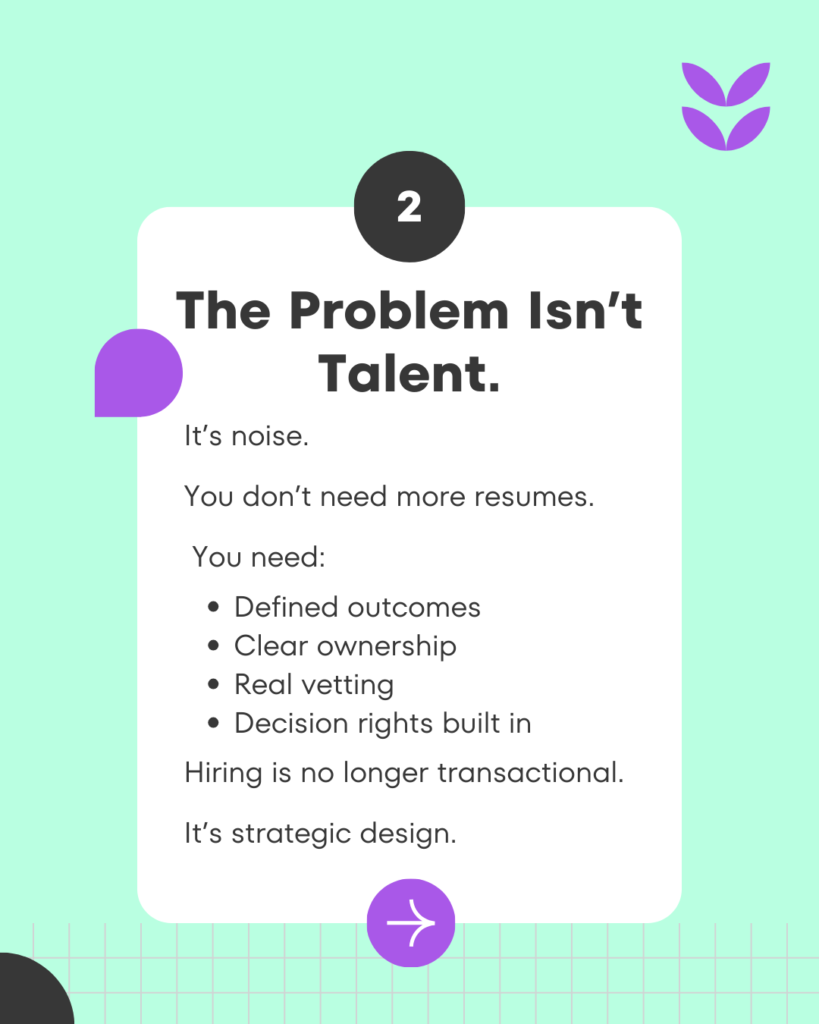
• Nobody helped Emma define what she actually needed.
• Nobody asked, “What will success look like 90 days from now?”
• Nobody said, “You don’t need a VA, you need a project coordinator.”

Marketplaces can’t ask those questions. They just match keywords. They don’t challenge business owners on what they think they need. Marketplaces are built for transactions, not transformations.

Good agencies are different. They sit with the messy notes from founders, the voice messages, the vague frustration of “I just need help,” and turn that into a clear process. They design a role before the hire.

That invisible work — the questioning, the clarifying, the diagnosing — is what turns a two-week freelancer into a two-year team member.

So stop the cycle of hiring before understanding.

Before hiring, take the time to:
1- Get help defining what you truly need.
2- Map the skills to your real priorities.
3- Make sure your new hire has the context to succeed.

The goal isn’t to fill a seat fast. It’s to know when Fiverr fits, and when it doesn’t.

Scroll to top