melgonz23

Later Is Where Standards Go to Die

Later Is Where Standards Go to Die

The most dangerous sentence in business is:

“We’ll fix it later.”

Later is where standards go to die.

Later is where small misalignments turn into culture problems.
Later is where top performers quietly disengage.
Later is where founders wake up wondering how things got so messy.

The truth?
What you tolerate today becomes tomorrow’s norm.

• A missed deadline you don’t address.
• A client boundary you don’t reinforce.
• A role you know isn’t clearly defined.
• A team member who’s overwhelmed but says “I’m fine.”

None of these explode overnight.
They compound.

Strong companies aren’t built on grand strategy alone.
They’re built on small corrections made quickly.

The best leaders I know don’t avoid tension.
They shorten the time between noticing and addressing.

Not aggressively.
Not emotionally.
Just clearly.

If something feels slightly off right now,
it probably is.

The question isn’t “Can we live with this?”
It’s “Do we want this to become the standard?”

What you fix early becomes strength.
What you delay becomes friction.

Choose wisely.

Please follow and like us:

Better Leadership Starts with Fewer Decisions

Better Leadership Starts with Fewer Decisions

Most leaders don’t burn out from working too much.
They burn out from deciding too much.

Every day, founders make hundreds of micro-decisions:
Do I answer this now or later?
Should I jump into this thread?
Is this “good enough” or do I tweak it again?

None of them feel heavy on their own.
But together, they quietly drain clarity, patience, and creativity.

Here’s the shift that changed everything for me:

I stopped asking, “What should I do?”
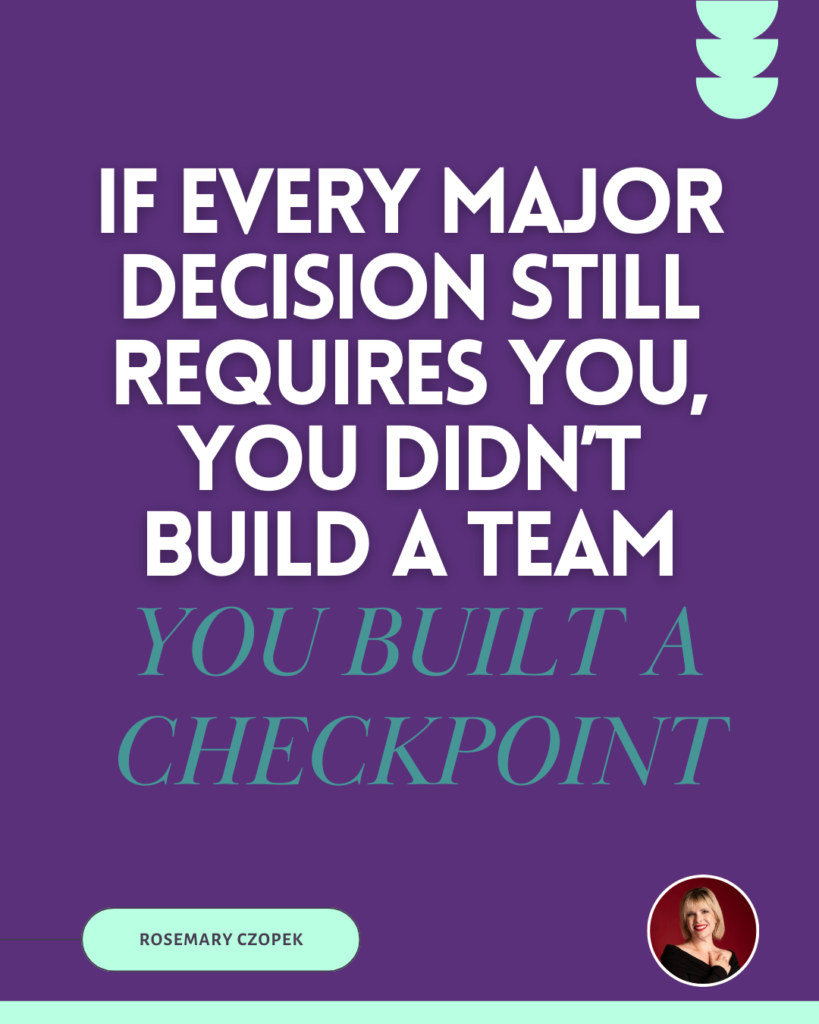
and started asking, “Who should decide this?”

Great leadership isn’t about having better answers.
It’s about reducing unnecessary decisions so the important ones get your best energy.

When you design your business to protect your thinking time:
• Your judgment improves
• Your reactions slow down
• Your leadership gets calmer and more intentional

If your days feel noisy, scattered, or reactive, it’s usually not a workload problem.
It’s a decision design problem.

Less friction.
Fewer decisions.
Better leadership.

Please follow and like us:

The Identity Shift No One Talks About

The Identity Shift No One Talks About

There’s a moment every founder hits that no one prepares you for.

It’s when the business is finally “working”
but you feel more tired than ever.

Revenue is up.
The team is growing.
Opportunities keep coming.

And yet, something feels off.

That moment usually isn’t about workload.
It’s about identity.

You’re still operating like the person who had to do everything.
Even though the business no longer requires that version of you.

So you stay involved where you shouldn’t.
You hold onto decisions that don’t need you.
You solve problems that are no longer yours to solve.

Growth quietly asks you to let go of an old role
before it hands you a new one.

Most burnout at this stage doesn’t come from the business.
It comes from refusing to evolve with it.

The hardest part of scaling isn’t building systems or hiring people.
It’s redefining who you need to be now.

If your business has outgrown the version of you that built it
that’s not a failure.

It’s an invitation.

And the sooner you accept it
the lighter everything else becomes.

Please follow and like us:

What It Takes to Scale with Purpose

What It Takes to Scale with Purpose

Grateful for an incredibly insightful conversation today with Mely Torres,

Founder of On Point Strategy (OPS), on my podcast The Hiring Conversation.

We talked about what it really takes to build and scale a mission-driven business, including remote team management, hiring high-performing talent, and how to create strong systems and accountability when your team isn’t all in the same place.

Mely shared such thoughtful perspective on leadership, growth, and building a team that can truly execute.

Thank you again, Mely, I loved the conversation and can’t wait to share this episode soon!

Carmen A. (Mely) Torres

Please follow and like us:

Growth Always Feels Too Far at First

Growth Always Feels Too Far at First

As a 3-time entrepreneur, I’ve learned something the hard way:
You don’t build something meaningful by playing it safe.

Every business I’ve started required me to step into discomfort—
– to make decisions before I had “proof,”
– to invest before the outcome was guaranteed,
– to hire before I felt “ready,”

and to bet on people before the world could see what I saw.

And now, as someone who hires and builds teams globally, I see this quote show up in real time through the people I place and work with.

The best talent isn’t always the most polished.

It’s the people who:
– take initiative before being asked
– lead without needing permission
– learn faster than they hesitate
and stretch themselves into roles they’ve never held before

The truth is… growth always looks like “too far” at first.

But that’s exactly where the breakthroughs live.

If you’re building something right now and it feels uncomfortable, risky, or a little insane…

You might be closer than you think.

Please follow and like us:

Depth, Presence, and Real Curiosity

Why Hiring Often Makes Things Worse

I used to think hiring would fix the pressure.

More hands.
More help.
Less on my plate.

But here’s the truth most founders learn the hard way:

Hiring doesn’t solve chaos.
It multiplies it.

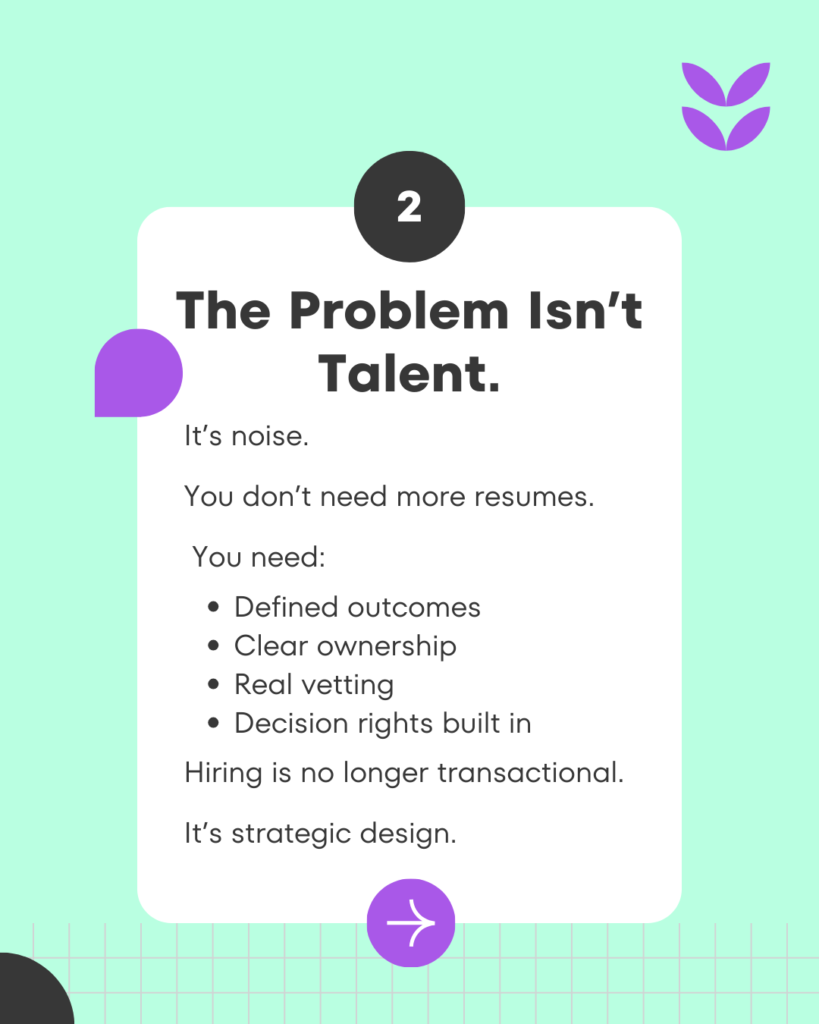
When there’s no clarity, no process, no definition of success, every new hire just adds more decisions, more questions, and more stress.

Staffing done right isn’t about filling seats.
It’s about removing weight.

Real staffing looks like this:
• A role is designed before someone is hired
• Outcomes are clear, not assumed
• Context lives in systems, not in Slack messages
• A new hire creates relief, not more work

If onboarding feels heavier than before, that’s not a people problem.
That’s a design problem.

The goal of staffing isn’t to make you the manager of more people.
It’s to make your business less dependent on you.

When you hire with intention, structure, and clarity, something powerful happens:
You stop being the glue.
Your team starts owning the work.
And your business finally has room to scale.

Hiring shouldn’t feel like a gamble.
It should feel like relief.

If your last hire added stress instead of removing it, what do you think was missing?

Please follow and like us:

When Effort Stops Being the Answer

When Effort Stops Being the Answer

One of the hardest shifts for high performers is realizing that effort is no longer the problem.

At a certain level, working harder doesn’t create better outcomes.
It just creates fatigue.

What actually moves things forward is precision.

Knowing where your attention creates the most leverage.
Knowing which decisions matter and which don’t.
Knowing when to stop pushing and start designing better systems.

I see so many leaders burn energy on things that shouldn’t require them anymore. Not because they’re incapable of letting go, but because no one ever showed them how to replace effort with structure.

The goal isn’t to do less.
It’s to do what only you can do.

When you make that shift, work feels lighter.
Decisions feel cleaner.
And progress stops feeling forced.

If everything feels heavy right now, it might not be because you’re doing too little.
It might be because you’re doing too much of the wrong things.

Please follow and like us:

EP 03: Hiring with Purpose How Founders Build Teams That Actually Last

In this episode, Rosemary sits down with Yasaman, founder of MIA Migration, to talk about what really goes into hiring and building teams that last, especially in fast moving startup environments.

Yasaman shares lessons from hiring and firing over 500 people across hospitality, tech, and immigration, reflecting on how her early experiences shaped the way she hires today. She opens up about red flags, green flags, trusting your gut, and why passion for the mission matters more than resumes, titles, or paychecks.

From redesigning the interview process to navigating hiring in a world influenced by AI, Yasaman offers honest insights on what works, what doesn’t, and why taking more time to hire often leads to better long term outcomes.

This conversation is a grounded and practical look at hiring, leadership, and decision making, with real world lessons for founders, managers, and anyone responsible for building teams.

Check out this episode!

Please follow and like us:

Entrepreneurship, Focus, and Freedom Over Coffee

Entrepreneurship, Focus, and Freedom Over Coffee

Had such a great breakfast in Puerto Rico with Todd Smart from EO Puerto Rico ☕️🌴

One thing I always appreciate about Puerto Rico is how connected and genuinely amazing the people are, whether they’re from the island or chose to make it home. There’s always so much depth, perspective, and real connection in the conversations here.

Todd and I shared stories about entrepreneurship, and he told me more about Blom Growth, how their coaches and software are helping businesses scale at unprecedented speed and with more freedom. He also shared insights from his book Flourish, which is all about transforming your business through focus, freedom, and fun, three things every entrepreneur could use more of 📘✨

Thank you for the inspiring breakfast, Todd. Grateful for conversations like this and the community that makes them possible 🙏

Please follow and like us:

More People Don’t Mean Less Burnout

More People Don’t Mean Less Burnout

Hiring won’t fix burnout.
I know that’s not what most founders want to hear.

When you’re exhausted, overwhelmed, and carrying too much, hiring feels like the solution.
More hands. Less pressure. Finally some relief.

But here’s what I see over and over again 👇
Burnout usually isn’t a people problem.
It’s a design problem.

If a hire adds more decisions, more explaining, or more mental load, the burnout doesn’t go away. It just gets louder.

That’s why these three things matter before you hire:

1️⃣ Hire for relief
A good hire should give you back time, focus, and mental space. If you don’t feel relief after onboarding, something is off.

2️⃣ Avoid unicorn roles
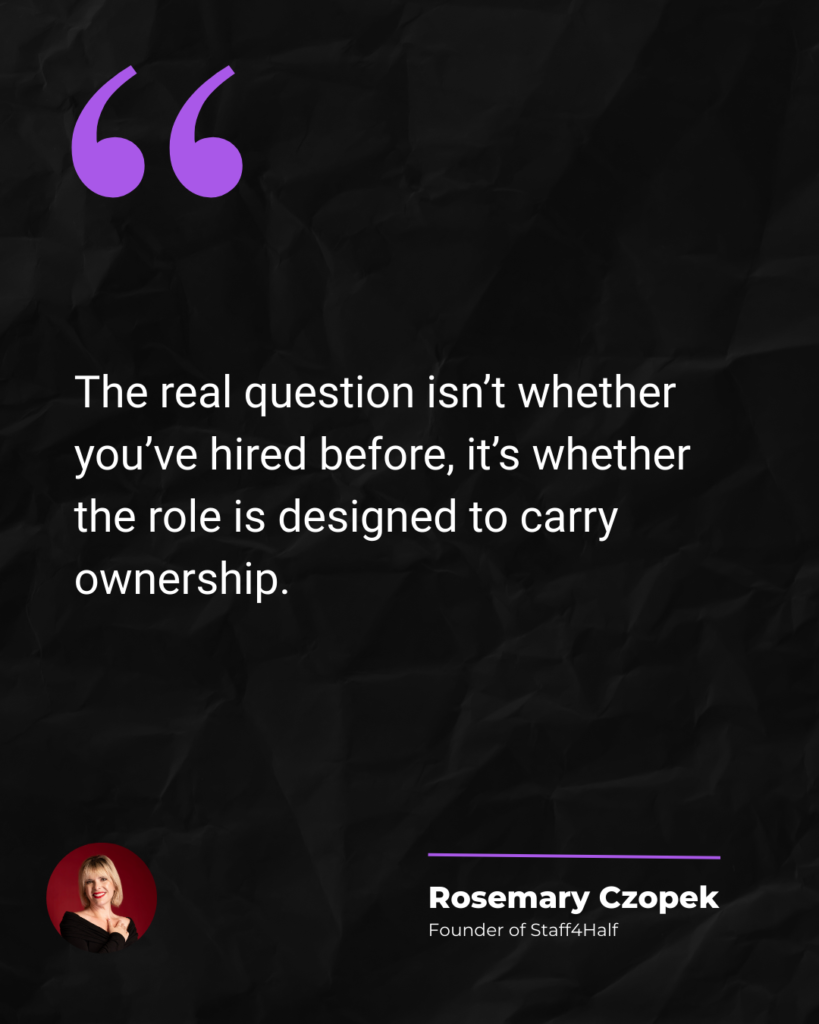
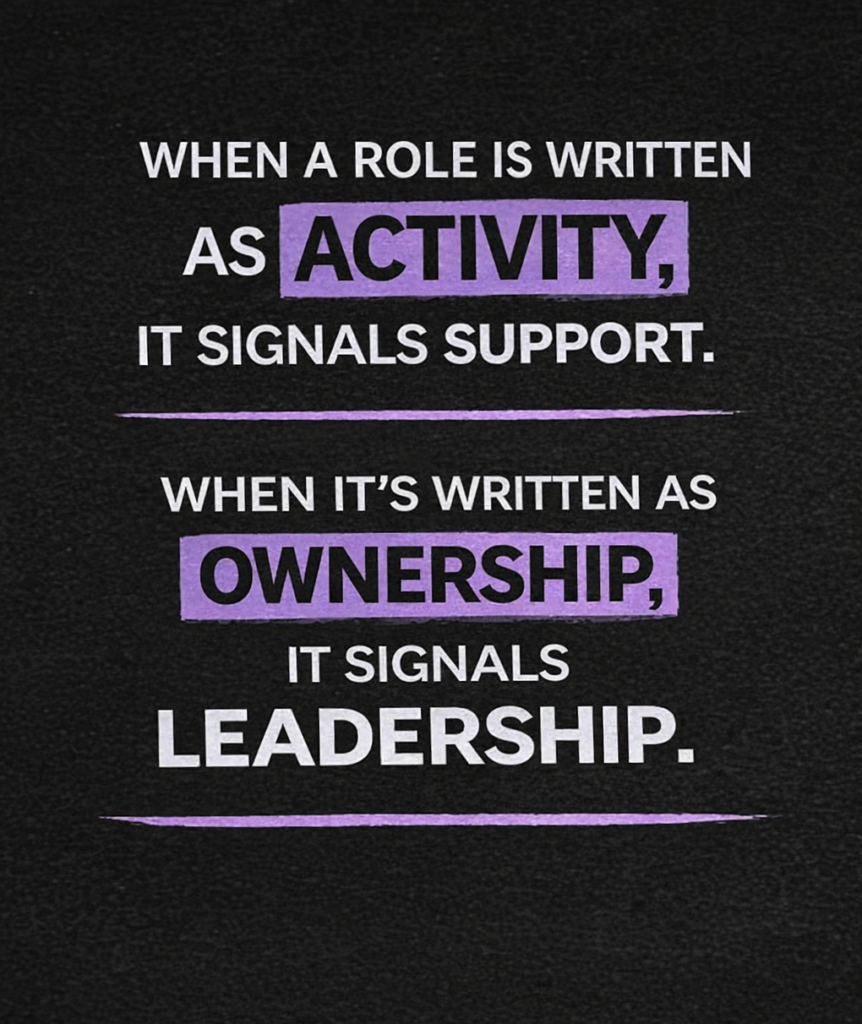
Clarity beats talent every time. When roles are vague, even great people struggle. Clear roles create ownership and confidence on both sides.

3️⃣ Scale from enough
Stability comes first. Growth should build on what already works, not try to rescue what’s broken.

At Staff4Half, we help founders build reliable remote teams in LATAM that actually reduce pressure instead of adding chaos.
Because hiring should support your life, not drain your energy.

If this resonates, you’re not behind.
You’re just ready to hire differently.


https://www.linkedin.com/posts/rosemary-czopek_3-tips-before-you-hire-activity-7423008373664739328-l0Ee?utm_source=share&utm_medium=member_desktop&rcm=ACoAAAFbvTABkvCLRpsoUttdPJ7c7BEJNAJNW04

Please follow and like us:
Scroll to top