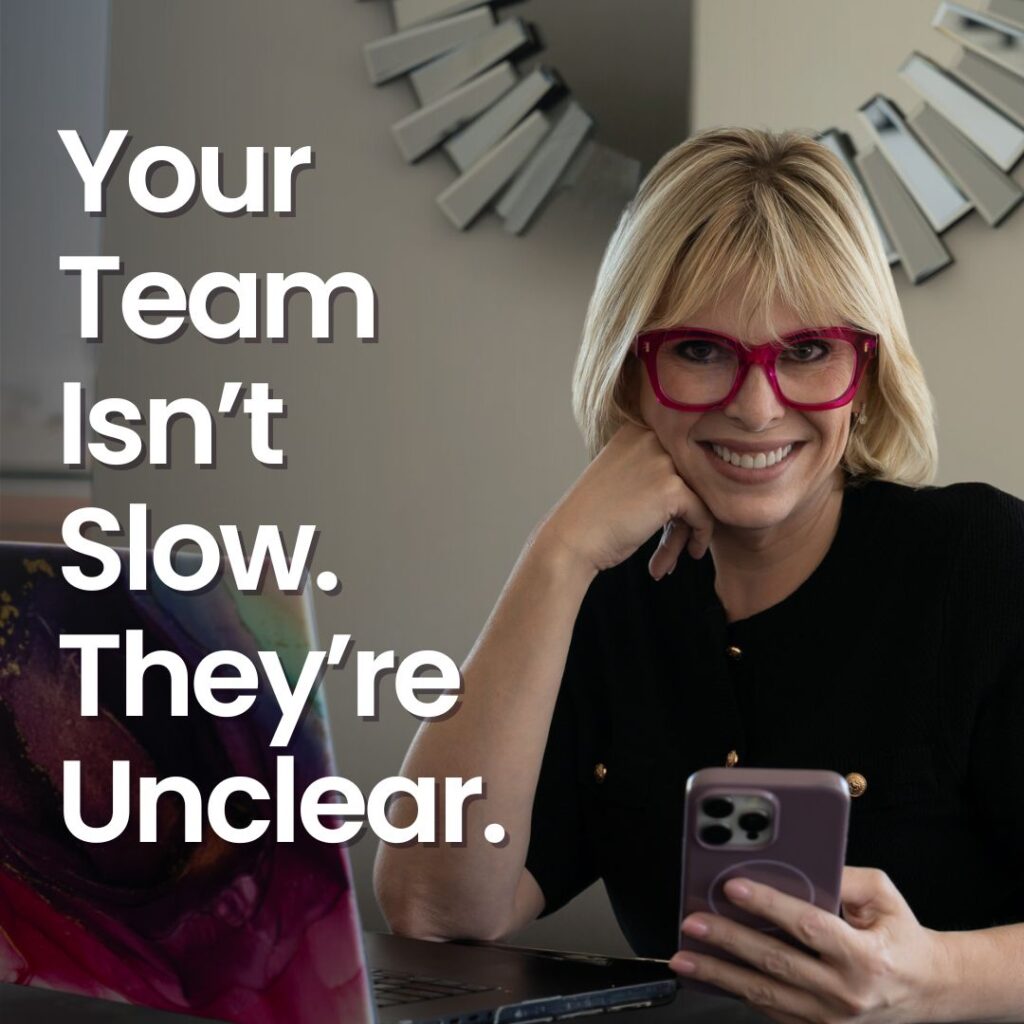
One of the hardest lessons in leadership is realizing that good intentions don’t translate into good outcomes.
You can care deeply.
You can work hard.
You can want the best for your team.
And still create confusion.
I’ve seen leaders get frustrated when people don’t “take ownership,” don’t move fast enough, or don’t seem aligned.
But often, the missing piece isn’t motivation.
It’s orientation.
People can’t own what they don’t understand.
They can’t move confidently when the goalposts feel invisible.
They can’t make good decisions without context.
Leadership isn’t about being available all the time.
It’s about being intentional with what you communicate.
That means saying things like:
This is the priority right now.
This is what success looks like.
This is how decisions will be made.
This is what can wait.
When those things stay unsaid, teams fill the gaps with assumptions.
Assumptions turn into hesitation.
Hesitation turns into frustration on both sides.
The leaders who scale best aren’t the ones with the loudest voices or the most answers.
They’re the ones who remove ambiguity before it becomes a problem.
Clarity doesn’t slow you down.
It speeds everyone else up.
If something feels off on your team, pause before fixing people or processes.
Ask yourself:
What might still be unclear?
That question alone can change everything.
———————-
I help founders find and manage the right remote talent so their businesses can grow without burning out their teams, or themselves.
Need support that actually works? Send me a direct message.
You Might also like
-
Later Is Where Standards Go to Die
The most dangerous sentence in business is:
“We’ll fix it later.”
Later is where standards go to die.
Later is where small misalignments turn into culture problems.
Later is where top performers quietly disengage.
Later is where founders wake up wondering how things got so messy.
The truth?
What you tolerate today becomes tomorrow’s norm.
• A missed deadline you don’t address.
• A client boundary you don’t reinforce.
• A role you know isn’t clearly defined.
• A team member who’s overwhelmed but says “I’m fine.”
None of these explode overnight.
They compound.
Strong companies aren’t built on grand strategy alone.
They’re built on small corrections made quickly.
The best leaders I know don’t avoid tension.
They shorten the time between noticing and addressing.
Not aggressively.
Not emotionally.
Just clearly.
If something feels slightly off right now,
it probably is.
The question isn’t “Can we live with this?”
It’s “Do we want this to become the standard?”
What you fix early becomes strength.
What you delay becomes friction.
Choose wisely.
Post Views: 73 -
Chef Today
The Big Oxmox advised her not to do so, because there were thousands of bad Commas, wild Question.

-
Short Page Title Example
The Big Oxmox advised her not to do so, because there were thousands of bad Commas, wild Question.