Men tend to hire to plug a hole in their organization. It’s functional: a task, a role, a gap.
Women, on the other hand, often hire with their hearts. We look for chemistry, for someone we can connect with. We want to know if this person will fit into the culture, not just the job description.
Some might think that’s idealistic. I think it’s realistic, because culture drives performance.
When hiring for cultural fit, the stakes are also higher, because when every hire is an emotional investment, every mis-hire hurts twice as much.
That’s one of the reasons I started Staff4Half. I wanted an agency that understands how women hire, with empathy, connection, and care, and that can support female founders in making smart, sustainable hiring decisions.
We don’t just scan résumés for functional fits. We help founders find people who belong, who are a cultural fit in every sense. I believe the right person doesn’t just fill a role, she transforms the team.
P.S. Case in point: my VA, Amara Krausse Horlacher, who has become my second half, my second brain. This is only possible because we are emotionally aligned.
If you’ve ever felt the emotional weight of hiring, you’re not alone. And you don’t have to do it alone.
You Might also like
-
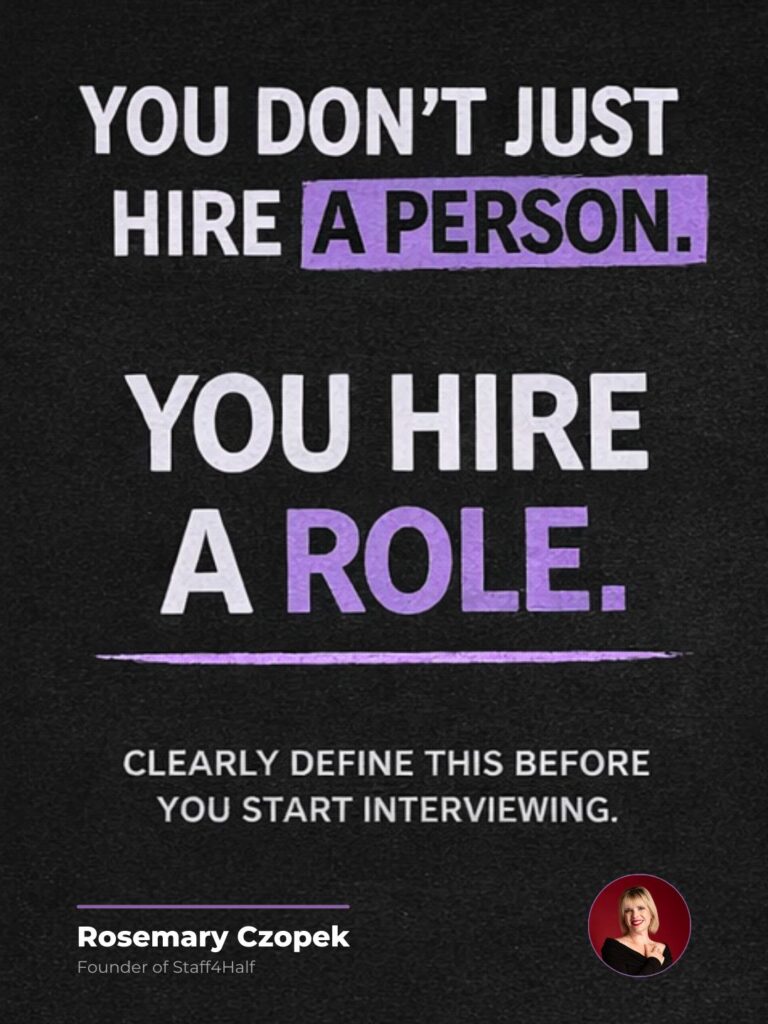
High performers don’t look for to-do lists. They look for territory.
We reviewed the job description.
Two full pages.
Tasks everywhere.
Update the CRM.
Coordinate meetings.
Manage the inbox.
Prepare reports.
Everything the person would do.
Nothing they would own.
Not a single defined outcome.
No decision authority.
No metric that was fully theirs.
This is where most hiring breaks down.
High performers don’t look for to-do lists.
They look for territory.
They want to know:
What result is mine?
What decisions can I make?
What metric am I accountable for?
When a role is written as activity, it signals support.
When a role is written as ownership, it signals leadership.
If your job description reads like tasks, you’ll attract executors.
If it defines outcomes, authority, and metrics, you’ll attract operators.
Clarity is a filter.
It doesn’t just define the role.
It defines who applies.
Quick founder question:
What are your job descriptions signaling right now?
Post Views: 24 -
When the System Forgets Entrepreneurs: Rethinking Employment in America
I didn’t start a company to be told which chair to buy, how many minutes a lunch break has to be, or whether my break room snacks meet code. I started it because I believed in building something better, and I wanted a team to build it with.
But what I’ve learned over 13 years as a California employer is this: the system doesn’t trust employers to care about their people. It assumes we’re out to exploit, and it assumes compliance creates care. So it piles on rule after rule, not realizing that the weight of all this regulation doesn’t protect good people—instead, I believe it crushes the ones who are trying to be good people.
As a female entrepreneur, I’ve always wanted to give my team the best. Yet I’ve spent more time worrying about lunch break laws than about how to help my people grow. To me, that’s not what leadership is supposed to look like.
Because I believe the best entrepreneurs do care. We remember birthdays. We pull all-nighters. We put payroll before profit. Not because a rulebook told us to, but because that’s who we entrepreneurs are. But somewhere along the way, the system forgot that.
It breaks my heart that the system stifles the very people who build businesses. And I believe that by doing this, we’re not protecting workers—we’re shrinking futures. More and more founders I know are looking abroad, not for cheaper labor, but for the freedom to lead well again.
And that should worry us all. Because when the American dream becomes unlivable for its dreamers, the dream doesn’t die—it just moves to another country.
Post Views: 501 -
The Old Hiring Model Doesn’t Work Anymore
I didn’t build Staff4Half because the world needed another staffing agency.
I built it because hiring has fundamentally changed — and most founders are still using old rules.
Ten years ago, hiring was simpler.
Post a job.
Review resumes.
Interview a few candidates.
Make an offer.Today?
Resumes are AI-polished.
Candidates apply to 200 roles in a click.
Skills shift faster than job titles.
Remote expands the talent pool — and the noise.And founders are overwhelmed.
The problem isn’t access to talent.
There’s more access than ever.The problem is signal vs. noise.
It’s knowing:
• Who can actually think, not just execute
• Who can own outcomes, not just complete tasks
• Who fits your pace, standards, and leadership styleHiring has moved from transactional to strategic.
It’s no longer about “filling a seat.”
It’s about designing leverage in a world where information is infinite and attention is scarce.That’s why I built Staff4Half.
Not to send resumes.
But to help founders:
• Define what they truly need
• Clarify ownership and outcomes
• Vet beyond surface-level credentials
• Design roles that actually create reliefBecause the old hiring model creates more activity.
The new hiring model creates scale.
And if you’re still hiring the old way, it’s going to feel harder every year.
Hiring isn’t broken.
It’s evolved.
And we help founders evolve with it.
Post Views: 120