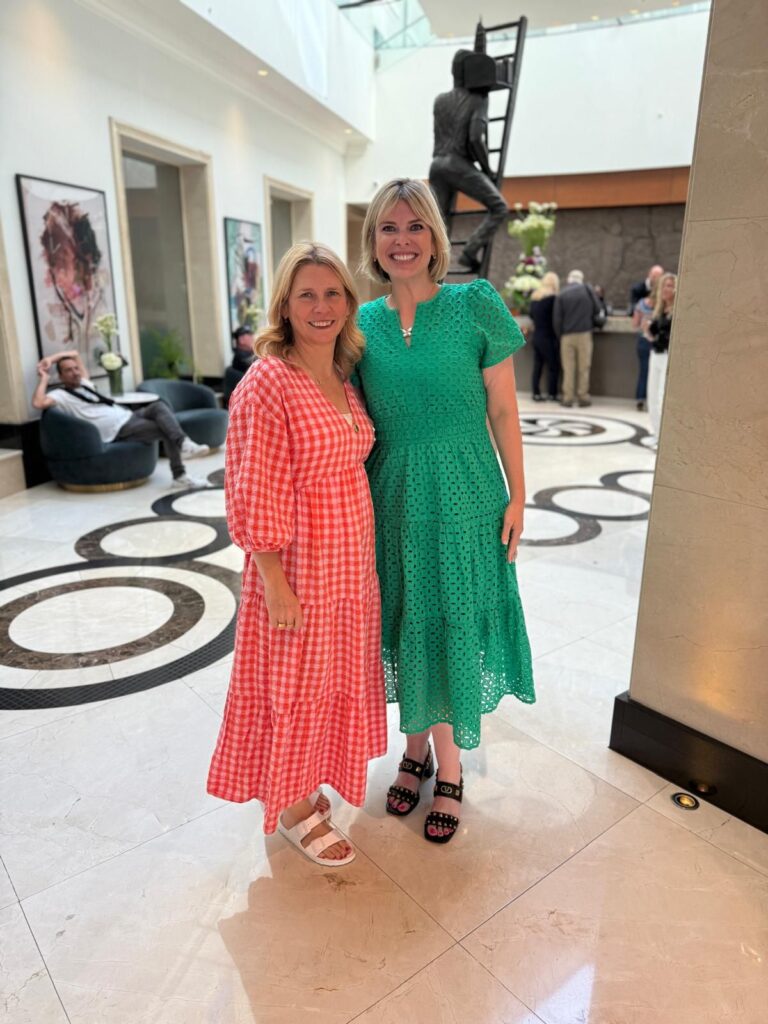
In this inspiring episode, host Rosemary Czopek sits down with Marlene Dandler, founder of Seashore Academy, to explore how a simple homeschooling idea at her kitchen table grew into a thriving educational enterprise.
Marlene shares how her journey, sparked by a mom’s desire for quality education, evolved into a full-scale in-person learning community that still prioritizes joy, hands-on learning, and excellence over spreadsheets. She built the school with no formal business plan, just a passion for community and doing what’s best for kids.
Marlene also opened up about her leadership journey, the lessons she’s learned through hiring, and how she balances on-site teachers with remote virtual assistants to keep operations smooth, efficient, and human-centered.
🎧 Tune in to hear how passion, purpose, and people-first leadership can turn a simple idea into a lasting legacy.
You Might also like
-
Cheaper Help to Aligned Help: The Story Behind Staff4Half
I thought I needed cheaper help. What I really needed was aligned help.
Back when I was running my California-based office supply business, Gorilla Stationers, payroll was my biggest expense and compliance headaches never seemed to stop. Despite paying top dollar, I couldn’t always count on the work getting done right. So I did what every cost-conscious entrepreneur eventually does: I hired offshore.
The Philippines made sense, great people, affordable rates. But then came the 2 a.m. Zoom calls. Not for me, but for my team abroad. I could hear the exhaustion in their voices, even when they smiled through it. The 12-hour time difference between the Philippines and the U.S. made me wonder: is this really how I want to grow, by making people labor through their nights? It felt unethical.
I didn’t want just cheap help. I wanted team members who could have a healthy work-life balance that worked for them and for me. And that shouldn’t be limited to my U.S. team.
That dilemma was still on my mind when I flew to Buenos Aires for an EO event. What I found surprised me:
✔️ U.S. time-zone alignment
✔️ A cost advantage compared to U.S. salaries
✔️ And a European-style culture of ownership and pride in workSo I decided to give it a try. I hired a VA to help me with my admin. That one hire turned into two. Then five. They helped me grow Gorilla Stationers while building a healthier team.
As I shared my experience, the inquiries started:
“Where did you find this person?”
“Can you help me get someone like that?”And just like that, Staff4Half was born, from solving my own talent problem in a way that finally felt aligned with my values, my clients, and my team.
If you’re tired of trading cost for quality, or ethics for output, I’ve been there. There’s a better way to build.
Post Views: 403 -
You Can’t Build Loyalty With a Tight Fist
Raising Salaries Won’t Fix Your Turnover Problem
I’ve seen companies with sky-high churn, and others paying exactly the same where employees stick around for years.
Both assume that’s just how it is. The struggling ones blame it on the salary, saying they can’t pay enough.
Here’s what I believe: turnover is rarely about the paycheck. It’s almost always about purpose.
When we get a new inquiry and see people leaving in waves, that’s not a pay problem. That’s a culture problem hiding in plain sight.
Often these companies pay well, yet people still leave. Meanwhile, the businesses with the lowest churn have something different in common: their people know why they’re there, because they feel part of something that matters.
I don’t believe people leave companies. They leave bosses and organizations that fail to give their work meaning.
If you want people to stay, you don’t need free kombucha or another salary bump. You need to lead with purpose. And sometimes, the smallest gestures mean the most:
• A thank you when it counts
• A birthday remembered
• A dinner where work doesn’t come upBefore you raise another salary, ask yourself: does each and every team member know why they’re here?
Post Views: 253 -
Everyone Knows an Emma (and That’s the Problem)
Everyone knows an Emma.
Emma, the founder drowning in to-dos.
Emma, who swore this month she’d finally get help.
Emma, who spent three hours on Fiverr trying to find “a VA who can do everything.” I call them unicorns.I’ve met many Emmas, and here’s what I’ve observed: Emma isn’t the problem. The hiring process is.
When her inbox hit 1,200 unread messages, Emma went to Fiverr. She typed “virtual assistant, reliable, proactive, English fluent” and hired someone in 48 hours. For two weeks, things looked fine. Then tasks slipped, instructions were repeated, and eventually, the VA disappeared mid-project.
So Emma said what many founders say in this situation:
“I guess I’m just bad at delegating.”
or
“There are no good people out there.”But here’s what really happened:
• Nobody helped Emma define what she actually needed.
• Nobody asked, “What will success look like 90 days from now?”
• Nobody said, “You don’t need a VA, you need a project coordinator.”Marketplaces can’t ask those questions. They just match keywords. They don’t challenge business owners on what they think they need. Marketplaces are built for transactions, not transformations.
Good agencies are different. They sit with the messy notes from founders, the voice messages, the vague frustration of “I just need help,” and turn that into a clear process. They design a role before the hire.
That invisible work — the questioning, the clarifying, the diagnosing — is what turns a two-week freelancer into a two-year team member.
So stop the cycle of hiring before understanding.
Before hiring, take the time to:
1- Get help defining what you truly need.
2- Map the skills to your real priorities.
3- Make sure your new hire has the context to succeed.The goal isn’t to fill a seat fast. It’s to know when Fiverr fits, and when it doesn’t.
Post Views: 217