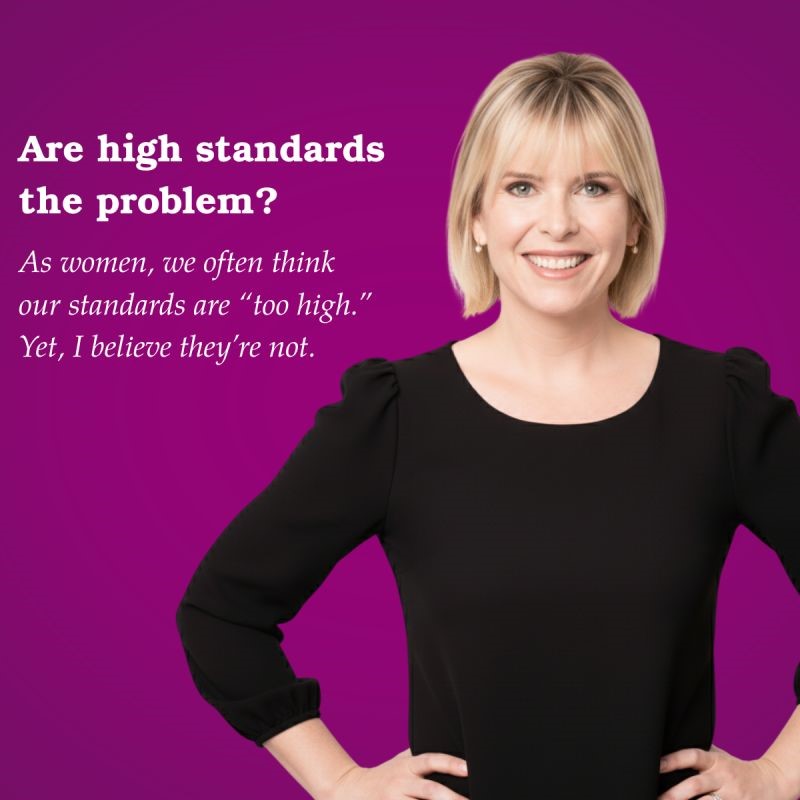
I believe that as female founders, high standards are our strength.
Women founders often second-guess themselves. We ask for excellence, then wonder if we’re being too demanding. We hold people accountable, then feel guilty for making someone uncomfortable.
But high standards aren’t harsh. They’re clarity. They protect our teams, our clients, and the purpose we’re building toward.
Strong boundaries aren’t unfair. They help the right people rise.
And when someone isn’t aligned, letting go isn’t failure. It’s leadership with compassion.
Because we can be kind and still be clear. We can care deeply and still expect excellence. That’s not a contradiction.
That’s respect — for ourselves, for our vision, and for the people we lead.
So don’t shrink your standards to make others comfortable. They exist for a reason. And they keep you, and your business, aligned with what matters most.
You Might also like
-
Cheaper Help to Aligned Help: The Story Behind Staff4Half
I thought I needed cheaper help. What I really needed was aligned help.
Back when I was running my California-based office supply business, Gorilla Stationers, payroll was my biggest expense and compliance headaches never seemed to stop. Despite paying top dollar, I couldn’t always count on the work getting done right. So I did what every cost-conscious entrepreneur eventually does: I hired offshore.
The Philippines made sense, great people, affordable rates. But then came the 2 a.m. Zoom calls. Not for me, but for my team abroad. I could hear the exhaustion in their voices, even when they smiled through it. The 12-hour time difference between the Philippines and the U.S. made me wonder: is this really how I want to grow, by making people labor through their nights? It felt unethical.
I didn’t want just cheap help. I wanted team members who could have a healthy work-life balance that worked for them and for me. And that shouldn’t be limited to my U.S. team.
That dilemma was still on my mind when I flew to Buenos Aires for an EO event. What I found surprised me:
✔️ U.S. time-zone alignment
✔️ A cost advantage compared to U.S. salaries
✔️ And a European-style culture of ownership and pride in workSo I decided to give it a try. I hired a VA to help me with my admin. That one hire turned into two. Then five. They helped me grow Gorilla Stationers while building a healthier team.
As I shared my experience, the inquiries started:
“Where did you find this person?”
“Can you help me get someone like that?”And just like that, Staff4Half was born, from solving my own talent problem in a way that finally felt aligned with my values, my clients, and my team.
If you’re tired of trading cost for quality, or ethics for output, I’ve been there. There’s a better way to build.
Post Views: 922 -
Experience helps you move faster. Structure keeps you from hitting the trees.
Experience helps you move faster. Structure keeps you from hitting the trees
A founder told me that recently.
And to be fair, he had.
Multiple companies.
Dozens of hires.
Experience matters.
But experience doesn’t protect you from structural mistakes.
We reviewed the role he was trying to fill.
Smart candidate profile.
Strong compensation.
Clear urgency.
But the role itself was blurry.
No real ownership.
Decisions that still escalated upward.
Success defined more by activity than outcome.
It reminded me of skiing.
You can be a great skier and still crash if your alignment is off.
Skill helps — but physics still wins.
Hiring works the same way.
At early stages, small design mistakes are survivable.
The team is small.
The founder fills the gaps.
But as the company grows, those same design flaws get expensive.
More people depend on the role.
More decisions pass through it.
More momentum gets tied to it.
Experience helps you move faster.
Structure keeps you from hitting the trees.
So the real question isn’t whether you’ve hired before.
It’s whether the role itself is designed to carry ownership.
Post Views: 158 -
Leadership That Starts at the Kitchen Table
Marlene Dandler built her company and a community from her kitchen table.
This week, I sat down with Marlene Dandler, founder of Seashore Academy, a fast-growing network of private hybrid schools that started right there — at her kitchen table.
What inspired me most wasn’t just how far she’s come, but how she leads: with clarity, care, and the conviction that great education, and great leadership, both start with human connection.
My three top takeaways:
1️⃣ Hiring for alignment, not background
Marlene explained that her toughest hires were leaders from traditional education, talented people who struggled to embrace Seashore Academy’s flexible hybrid model. What finally worked was finding a leader who shared her excitement for change and innovation.2️⃣ Leadership energy trickles down
She compared leading her company to parenting: when she’s calm, the household, or the business, is calm. Her morning run and prayer aren’t just self-care, they’re her leadership practices.3️⃣ Culture travels through connection
She keeps her on-site and remote teams united through short daily video huddles and by sharing photos from the classrooms, reminding everyone, even those thousands of miles away, of the joy they’re helping create.Conversations like this remind me how much leadership is about intention — who we hire, how we show up, and how we stay connected across distance.
Grateful to Marlene for sharing her story, her heart, and her wisdom.
Full episode coming soon.
Post Views: 674