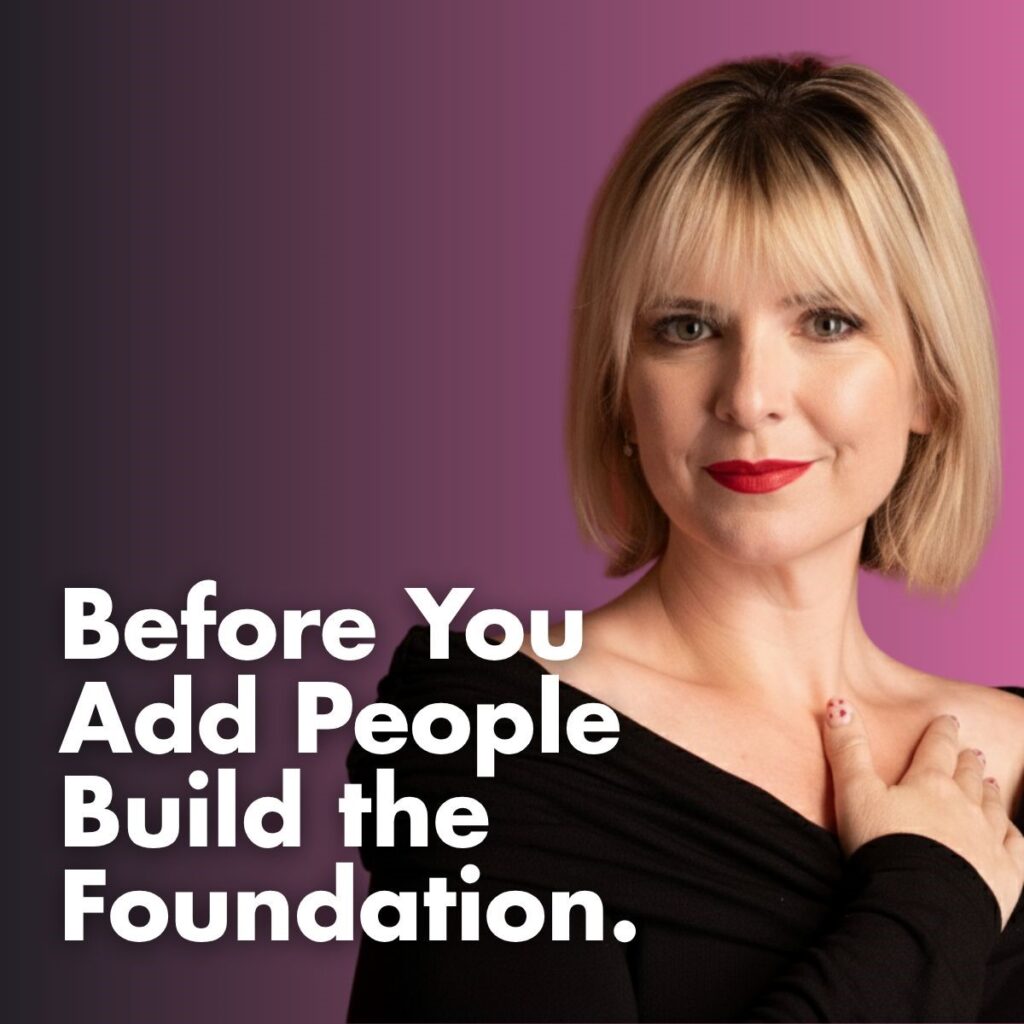
Before you hire, ask yourself this: am I ready for a new team member?
A lot of founders are in pain. Overwhelmed. Buried in tasks. Stretched too thin and running on fumes.
So they do what feels logical: they hire someone. Maybe a VA, maybe an operations manager, someone to finally take things off their plate.
And here’s what I’ve seen again and again: if the foundation isn’t ready, the hire won’t save you. Most people don’t come in and build systems for you. They execute what’s already there.
So before you hire, ask yourself:
• Are your workflows documented?
• Do you know what success looks like in this role?
• Is there one central place for tasks and communication?
• Are you available to onboard and give context for the first two to four weeks?
If the answer is no, even the best hire will feel lost—and so will you.
Hiring doesn’t fix chaos. It amplifies it.
And yet, this happens all the time: founders hiring to feel productive instead of getting prepared, adding people instead of fixing systems, confusing motion for progress.
Hiring isn’t about making you feel less lonely in your business. It’s about making it run better. And that only works when there’s clarity.
So the next time you’re tempted to post that job listing, pause and ask yourself: are my systems ready?
The right hire can be transformational, but only when the business is ready to receive them.
You Might also like
-
Why Reducing Uncertainty Is a Leadership Skill

One of the most underestimated leadership skills is the ability to reduce uncertainty.
Not by controlling everything.
Not by having all the answers.But by creating a sense of direction people can trust.
Most teams don’t stall because they’re lazy or unmotivated. They stall because too much feels unclear at once. Priorities shift. Decisions feel inconsistent. Context is missing.
So people slow down.
They double check.
They wait for permission.
They hesitate instead of acting.What looks like a performance issue is often an orientation issue.
Good leadership gives people a stable reference point.
What matters right now.
How choices will be made.
What success looks like in this moment.That clarity doesn’t need to be perfect. It just needs to be steady.
When leaders are consistent, teams stop bracing and start building.
When people feel grounded, they take smarter risks.
When direction is clear, momentum returns.If your team feels tense or stuck, resist the urge to push harder.
Look instead at what might feel uncertain from their side.Leadership isn’t about accelerating people.
It’s about giving them solid ground to move from.———————-
I help founders find and manage the right remote talent so their businesses can grow without burning out their teams, or themselves.
Post Views: 249 -
Why AI Will Make Argentina Shine Even More
There’s been a lot of talk about how AI is changing outsourcing. I’d like to share what I’m seeing. For years, outsourcing meant sending low-complexity tasks to the cheapest countries: – Data entry. – Basic support. – Repetitive work. The kind of labour that was time consuming, and could be done with little judgment. AI is wiping that model out and the countries that built their economies on routine, high-volume work are feeling it first: – Philippines, – India, and – Bangladesh. And then there are the less prominent outsourcing countries that I believe will now shine more than ever. What countries are those? There are tasks where AI can do 80% of the task, but the remaining 20% require something completely different: – reasoning, – communication, – clarity, and good judgment. And that is exactly where Argentina shines. When I first started working with Argentina, I didn’t know what to expect, and what I found was something AI can’t replace: – creativity, – sharp thinking, and a level of – cultural alignment that makes collaboration effortless. What used to be “outsourcing” has become something different: Smart outsourcing. People who supervise AI, not compete with it. People who can make decisions, solve problems, and communicate clearly and use AI to 10x their output. That’s why I am so excited about the future of Argentina because the people in Buenos Aires, Córdoba, and Rosario are not “cheap talent.” They’re exceptional talent in a world where exceptional matters more than ever. AI is changing outsourcing and as it does that, it’s also revealing something important: The future belongs to countries with judgment, adaptability, and talent density. And Argentina is one of the strongest examples I’ve ever seen.
Post Views: 314 -
Why Every Founder Needs an Organizational Chart

Most founders I know don’t actually have one job, they have three. Or five. Or ten. I’ve been there myself: one hat for sales, one for operations, one for HR, and another for customer service (all before lunch)
What does that mean for hiring? Too often, when we try to hire in the middle of that chaos, we end up writing job descriptions based on our overwhelm, not on a clear map of the company. That’s why coaching systems like EOS, Bloom Growth, and Scaling Up all push leaders to build an organizational (or accountability) chart.
I used to think: how boring. Until I realized it’s not just a chart, it’s a mirror.
When I first drew mine, I suddenly saw:
-
I was holding three roles.
-
Some teammates were holding half a role.
-
And some roles didn’t even exist.
Once that truth was on paper, I was finally able to play the jigsaw puzzle, moving responsibilities left, right, up, and down until every role made sense (and I had less on my plate).
Only then can you:
✔️ Write job descriptions that actually stick
✔️ Carve out tasks without leaving holes
✔️ Stop hiring “a warm body to do stuff”Most small companies never do this exercise. But the ones who do unlock a level of clarity that makes scaling possible.
Have you ever done the organigram exercise? What surprised you most when you saw your company on paper?
Post Views: 493 -

