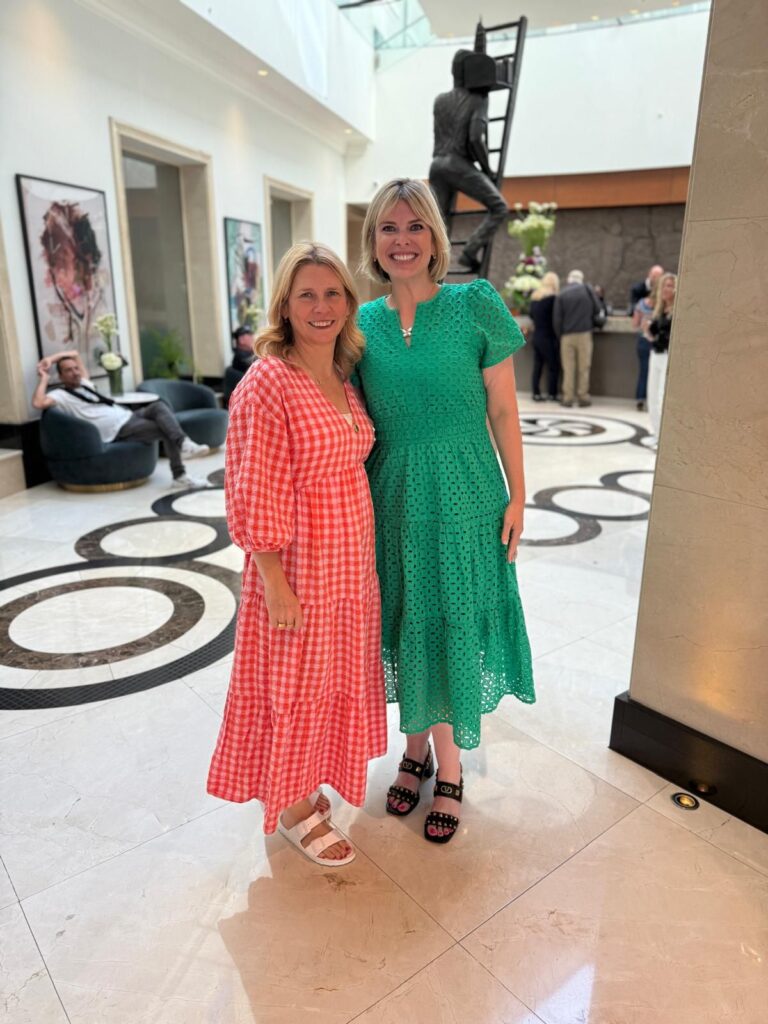
I barely checked my email for the past two weeks and drastically reduced my workload. It’s summer, and I’ve been traveling through Europe. On my way to Bulgaria, I had breakfast with Janet Bell, who happened to be here as well. Janet and I have known each other for years, going back to our time in OPWIL (Office Products Women in Leadership).
Even though so much has changed around us, our connection was instant. We enjoyed coffee in the sun and talked about the changes AI is bringing to the office supply space.
That conversation reminded me of something I’ve come to appreciate deeply: as business owners, we need to build companies that can run without us. If my business can’t operate while I’m away, while I’m traveling, then it’s time to redesign the system.
Here’s what made that possible for me:
✔️ Delegation rooted in trust
✔️ Systems that carry the weight
✔️ People who show up and take ownership
It sounds so obvious and even banal, yet it took me years to get right. And I see so many business owners who know this, yet still struggle to find the right people who allow them to let go.
This trip gave me gratitude for the freedom I’ve been able to build.
You Might also like
-
Depth, Presence, and Real Curiosity
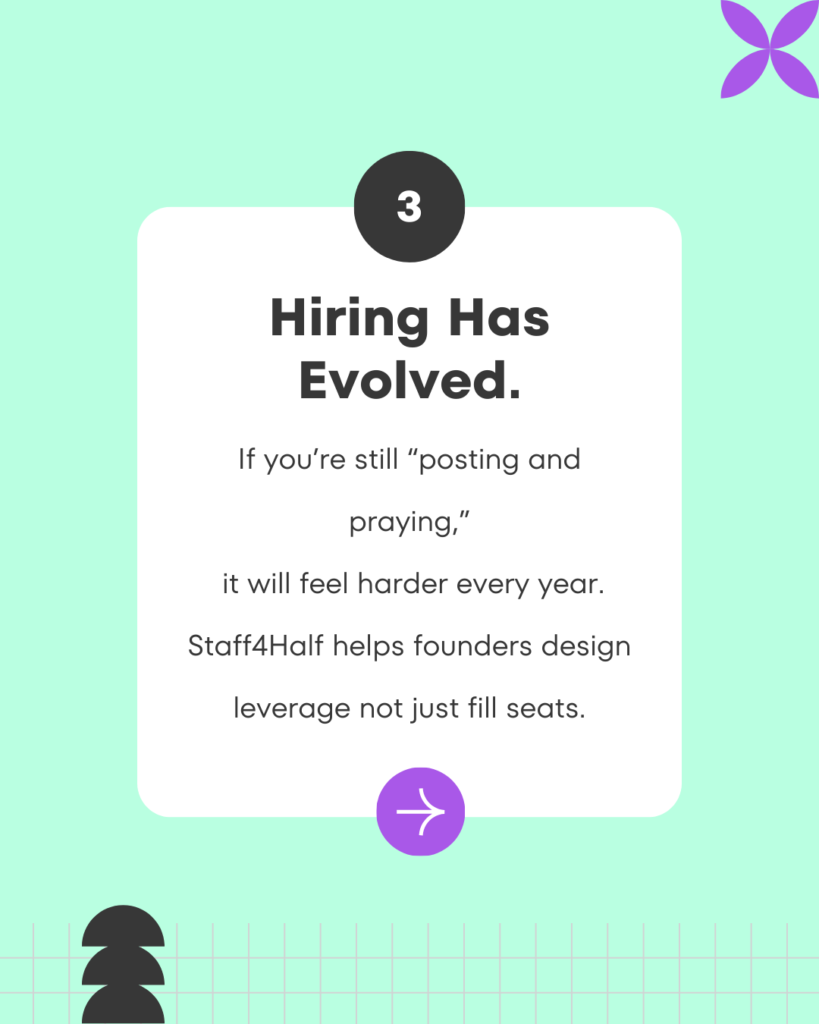
Why Hiring Often Makes Things Worse
I used to think hiring would fix the pressure.
More hands.
More help.
Less on my plate.
But here’s the truth most founders learn the hard way:
Hiring doesn’t solve chaos.
It multiplies it.
When there’s no clarity, no process, no definition of success, every new hire just adds more decisions, more questions, and more stress.
Staffing done right isn’t about filling seats.
It’s about removing weight.
Real staffing looks like this:
• A role is designed before someone is hired
• Outcomes are clear, not assumed
• Context lives in systems, not in Slack messages
• A new hire creates relief, not more work
If onboarding feels heavier than before, that’s not a people problem.
That’s a design problem.
The goal of staffing isn’t to make you the manager of more people.
It’s to make your business less dependent on you.
When you hire with intention, structure, and clarity, something powerful happens:
You stop being the glue.
Your team starts owning the work.
And your business finally has room to scale.
Hiring shouldn’t feel like a gamble.
It should feel like relief.
If your last hire added stress instead of removing it, what do you think was missing?Post Views: 82 -
Leadership That Starts at the Kitchen Table
Marlene Dandler built her company and a community from her kitchen table.
This week, I sat down with Marlene Dandler, founder of Seashore Academy, a fast-growing network of private hybrid schools that started right there — at her kitchen table.
What inspired me most wasn’t just how far she’s come, but how she leads: with clarity, care, and the conviction that great education, and great leadership, both start with human connection.
My three top takeaways:
1️⃣ Hiring for alignment, not background
Marlene explained that her toughest hires were leaders from traditional education, talented people who struggled to embrace Seashore Academy’s flexible hybrid model. What finally worked was finding a leader who shared her excitement for change and innovation.2️⃣ Leadership energy trickles down
She compared leading her company to parenting: when she’s calm, the household, or the business, is calm. Her morning run and prayer aren’t just self-care, they’re her leadership practices.3️⃣ Culture travels through connection
She keeps her on-site and remote teams united through short daily video huddles and by sharing photos from the classrooms, reminding everyone, even those thousands of miles away, of the joy they’re helping create.Conversations like this remind me how much leadership is about intention — who we hire, how we show up, and how we stay connected across distance.
Grateful to Marlene for sharing her story, her heart, and her wisdom.
Full episode coming soon.
Post Views: 405 -
Everyone Knows an Emma (and That’s the Problem)
Everyone knows an Emma.
Emma, the founder drowning in to-dos.
Emma, who swore this month she’d finally get help.
Emma, who spent three hours on Fiverr trying to find “a VA who can do everything.” I call them unicorns.I’ve met many Emmas, and here’s what I’ve observed: Emma isn’t the problem. The hiring process is.
When her inbox hit 1,200 unread messages, Emma went to Fiverr. She typed “virtual assistant, reliable, proactive, English fluent” and hired someone in 48 hours. For two weeks, things looked fine. Then tasks slipped, instructions were repeated, and eventually, the VA disappeared mid-project.
So Emma said what many founders say in this situation:
“I guess I’m just bad at delegating.”
or
“There are no good people out there.”But here’s what really happened:
• Nobody helped Emma define what she actually needed.
• Nobody asked, “What will success look like 90 days from now?”
• Nobody said, “You don’t need a VA, you need a project coordinator.”Marketplaces can’t ask those questions. They just match keywords. They don’t challenge business owners on what they think they need. Marketplaces are built for transactions, not transformations.
Good agencies are different. They sit with the messy notes from founders, the voice messages, the vague frustration of “I just need help,” and turn that into a clear process. They design a role before the hire.
That invisible work — the questioning, the clarifying, the diagnosing — is what turns a two-week freelancer into a two-year team member.
So stop the cycle of hiring before understanding.
Before hiring, take the time to:
1- Get help defining what you truly need.
2- Map the skills to your real priorities.
3- Make sure your new hire has the context to succeed.The goal isn’t to fill a seat fast. It’s to know when Fiverr fits, and when it doesn’t.
Post Views: 352