Lake Bled looked effortless. But I bled sweat and tears.
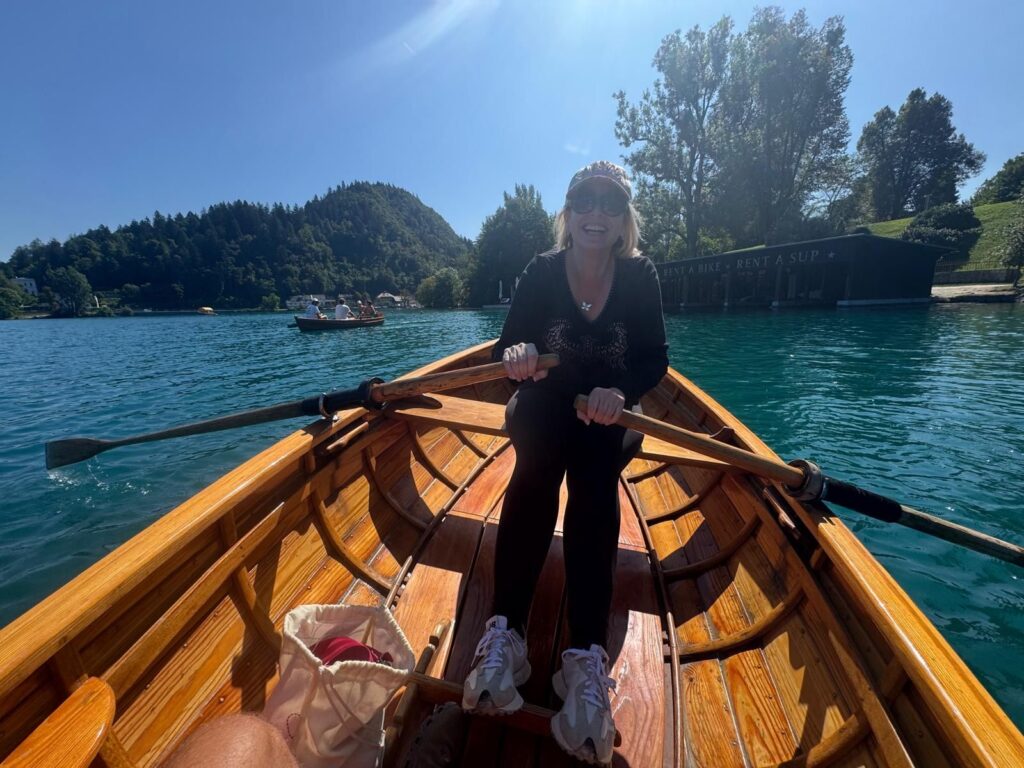
This week in Slovakia, I visited Lake Bled with a friend. People were gliding across the water, smiling, and rowing with one hand like they were born for it. I told my friend, “Let’s rent a boat. I’ll row, I’ve got this.” The fact was, I’d never used a rowboat before—but how hard could it be?
Turns out, very hard. The oars were stiff, the boat barely moved, and I kept zigzagging across the water like a drunk duck. Halfway to the island, my arms were already aching. After what felt like an eternity—but really was only twenty minutes—we landed on the island. I was ready for a break.
But the break didn’t last long, because we had to return the boat. My friend offered to row, and I heard myself say, “No thanks, I’ve got this.” Somewhere, deep in my brain, I believed that accepting help made me weak.
I grew up with a strong mother who carried her own suitcases and fixed things in the house herself rather than asking for help. That mindset shaped me. So I rowed. And rowed. And rowed. A sweaty mess, water running down my back, trying to prove something no one was asking me to prove.
That’s when I realized: this is how I used to lead Gorilla Stationers in the beginning. Doing it all. First in, last out. Trying to earn respect by powering through everything alone. Believing that, as the boss, I had to look strong and prove it was my business.
It took me a decade to understand: entrepreneurship isn’t rowing harder—it’s knowing when to hand over the oars while still owning the journey.
You Might also like
-
I Met a Billionaire. Here’s What Really Changed.
Founders think meeting a billionaire will chance their business. I met one. What did it change?” Last week, I spent a few days on Necker Island with Richard Branson as part of an Entrepreneurs’ Organization event. Beautiful setting, incredible hospitality, unforgettable activities. I expected some great insights and learnings from the conversations with Richard himself, an entrepreneur who’s achieved what we all can only dream about. Here’s what I didn’t expect: The most valuable conversations didn’t happen with Sir R, they happened with the other entrepreneurs in the room. People solving problems in businesses with real constraints. People asking the same questions I’m asking. What stayed with me wasn’t a quote from the stage or a moment of brilliance from Sir R. It was the honesty in late-night conversations. The feeling of being seen and understood among peers. The shared challenges and the practical ideas. The feeling of, “Oh, you’re dealing with that, too?” For me, inspiration doesn’t come from proximity to icons, it comes from relatable peers. People who understand my world because they’re living in it. And that’s the reason I keep coming back to EO over and over again, for the peer-to-peer learning that actually changes how I lead. The trip was unforgettable, the setting was surreal, but the real value? → The people sitting next to me, not the one standing on the pedestal. Renie Cavallari Santiago Roa Rebecca Massicotte Jane Bianchini
Post Views: 140 -
Why AI Will Make Argentina Shine Even More
There’s been a lot of talk about how AI is changing outsourcing. I’d like to share what I’m seeing. For years, outsourcing meant sending low-complexity tasks to the cheapest countries: – Data entry. – Basic support. – Repetitive work. The kind of labour that was time consuming, and could be done with little judgment. AI is wiping that model out and the countries that built their economies on routine, high-volume work are feeling it first: – Philippines, – India, and – Bangladesh. And then there are the less prominent outsourcing countries that I believe will now shine more than ever. What countries are those? There are tasks where AI can do 80% of the task, but the remaining 20% require something completely different: – reasoning, – communication, – clarity, and good judgment. And that is exactly where Argentina shines. When I first started working with Argentina, I didn’t know what to expect, and what I found was something AI can’t replace: – creativity, – sharp thinking, and a level of – cultural alignment that makes collaboration effortless. What used to be “outsourcing” has become something different: Smart outsourcing. People who supervise AI, not compete with it. People who can make decisions, solve problems, and communicate clearly and use AI to 10x their output. That’s why I am so excited about the future of Argentina because the people in Buenos Aires, Córdoba, and Rosario are not “cheap talent.” They’re exceptional talent in a world where exceptional matters more than ever. AI is changing outsourcing and as it does that, it’s also revealing something important: The future belongs to countries with judgment, adaptability, and talent density. And Argentina is one of the strongest examples I’ve ever seen.
Post Views: 151 -
They Cut Us Out. And Here’s What They Lost.
And no, I’m not mad. But I do want to tell you what they gave up.
Here’s what happened.
Two months after we placed a fantastic team member with a client, the client ended the contract. They went direct, cutting us out — even though it was against the agreement.
It’s a common assumption. They saw a great hire and figured they could just go direct and keep the magic going. From the outside, it looked like we added a markup and then disappeared.
But here’s what many business owners forget when they think like that.
We didn’t just plug in a person and walk away.
We listened when they told us what they needed.
We politely disagreed and recalibrated the role so it made more sense.
We filtered over a thousand candidates across three time zones.
We onboarded, aligned, and coached through the first thirty days.
We ran reviews, check-ins, and gave her a roadmap to thrive.
We stayed in the background to solve problems before they turned into churn.What they saw was a great hire.
What they missed was the system behind her success.Great hires aren’t just people. They’re the product of systems, coaching, and care.
If you’re not hiring every week, you don’t have hiring systems. You don’t have a ready pipeline or a backup plan. You don’t have time to coach, review, and replace.
And that’s the invisible value a good agency brings. It acts like a fractional HR department, always there to step in.
So yes, they saved money on paper. But with the next hire, they’ll be starting from scratch — without the systems that made this one thrive.
Post Views: 167