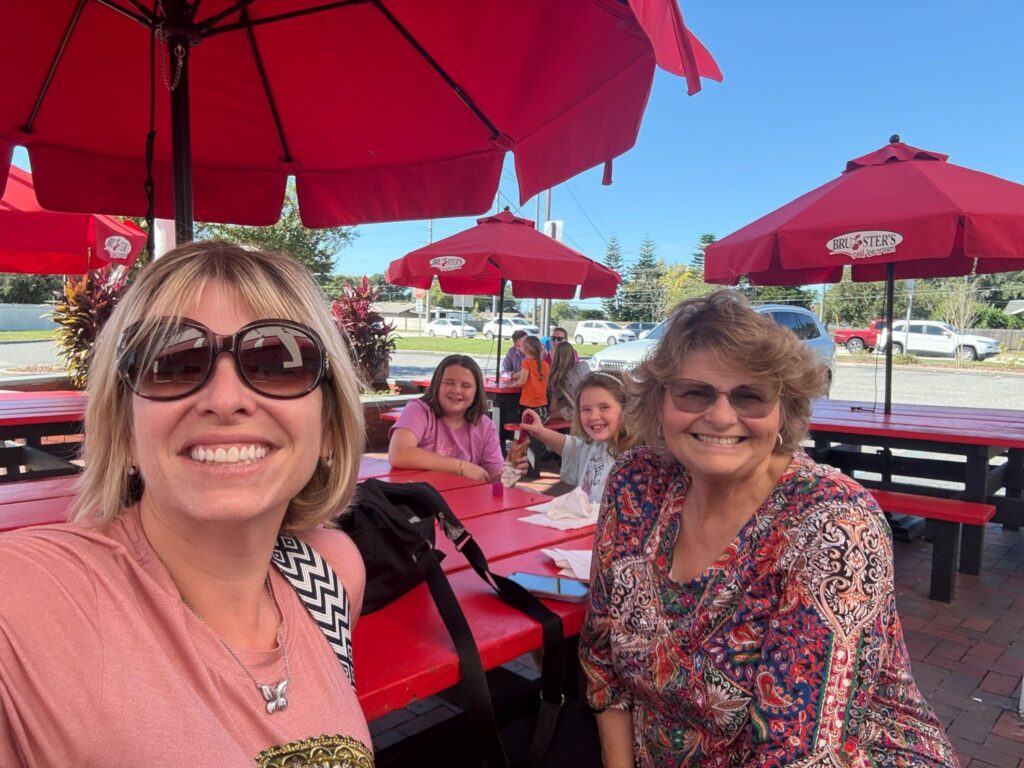
Ice Cream with My Mom 🥰
📍 Tampa, Florida, Monday, October 13
This isn’t a “look at me, I can take Mondays off” post.
It’s simply a reminder that our time with the people we love is finite, especially our parents.
If our businesses aren’t designed to make space for moments like this, then what’s the point of it all?
I’m deeply grateful for a team that allows not only me, but everyone on the team, to enjoy these moments.
Every person at Staff4Half has the same freedom and flexibility to design their work around what matters most in life, and that could very well be an ice cream on a Monday afternoon with mom and the nieces.
Three things that help us:
1️⃣ Design for redundancy. Cross-training and clear SOPs ensure that no single person becomes a bottleneck, myself included.
2️⃣ Protect moments that matter. We encourage teammates to block time for important family moments, no questions asked.
3️⃣ Lead with trust and clarity. When I take time off for moments like these, it sends a message that everyone can too.
Business is a vehicle, but the destination is a life you’re proud to live with the people you love. ❤️
You Might also like
-
When Effort Stops Being the Answer
One of the hardest shifts for high performers is realizing that effort is no longer the problem.
At a certain level, working harder doesn’t create better outcomes.
It just creates fatigue.
What actually moves things forward is precision.
Knowing where your attention creates the most leverage.
Knowing which decisions matter and which don’t.
Knowing when to stop pushing and start designing better systems.
I see so many leaders burn energy on things that shouldn’t require them anymore. Not because they’re incapable of letting go, but because no one ever showed them how to replace effort with structure.
The goal isn’t to do less.
It’s to do what only you can do.
When you make that shift, work feels lighter.
Decisions feel cleaner.
And progress stops feeling forced.
If everything feels heavy right now, it might not be because you’re doing too little.
It might be because you’re doing too much of the wrong things.
Post Views: 312 -
Why Teams Still Hesitate
Most leadership tension comes from one thing people rarely admit.
Unfinished decisions.
Not bad decisions.
Not wrong decisions.
Decisions that were never fully made or clearly communicated.
You see it when priorities keep shifting.
When people ask the same questions in different meetings.
When execution feels hesitant instead of decisive.
What’s happening underneath is uncertainty.
Teams can handle change.
They can handle bad news.
They can even handle tough goals.
What they struggle with is ambiguity that lingers.
Strong leaders close loops.
They say
This is the decision.
This is why we made it.
This is what it means for you.
This is what we are not doing right now.
That clarity creates relief.
People stop second guessing.
They stop waiting for permission.
They move with confidence because the ground feels solid again.
Leadership is not about keeping options open forever.
It is about knowing when it is time to choose and helping others move forward with you.
If your team feels stuck, look for the open loops.
They are usually where the energy is leaking.
Because the strongest teams are not the ones with the smartest answers.
They are the ones asking the best questions together.
Post Views: 214 -
Remote didn’t create the problem. It revealed it.
That’s what a founder told me.
So we looked at the structure.
No written decision rights.
No documented processes.
No defined response expectations.
No escalation framework.
Accountability wasn’t missing.
Clarity was.
When teams work in the same office, ambiguity hides.
People overhear conversations.
They interrupt each other.
Decisions happen informally.
Things move… even when the system is weak.
Remote work removes that safety net.
Silence exposes structure.
If ownership isn’t defined, work stalls.
If decision rights aren’t clear, everything escalates.
If processes aren’t written, people wait.
Remote didn’t create the problem.
It revealed it.
Strong companies don’t rely on proximity.
They rely on structure.
Decision rights travel.
Ownership travels.
Clarity travels.
And when they do, location stops mattering.
Quick question for founders running remote teams:
If someone new joined your team tomorrow, could they clearly see what they own and what they can decide — without asking you?
Or would they have to figure it out through Slack messages and meetings?
Structure is what makes remote work scale.
Post Views: 102